Recently, I’ve been facilitating strategic planning workshops with school leaders and I have found the 'underlying dynamics' a powerful lens for understanding what good strategic planning really requires.
Rather than a few people developing a plan on others' behalf, ToP methods use the underlying dynamics to shift the focus onto the process: enabling genuine participation, drawing out new ideas, and building real commitment.
What are the underlying dynamics:
The underlying dynamics are a meta-structure sitting within every ToP method and group process. Here's how I've been using them with school communities:
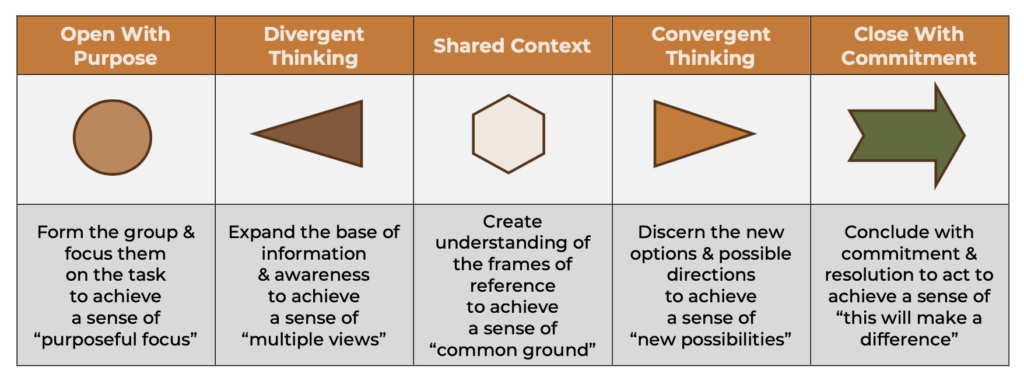
Open with purpose:
Trust has to be built first, or people won't feel safe contributing. I once worked with a group ready to jump into action planning, but after two sessions hitting a brick wall, we had to come back to this basic level. People need to understand why the change is happening, and to see the plan connected to what gives them purpose and value. A good way to do this is to word the purpose as an open question and when highlighting it, ask about the importance of the topic for the people involved, and in the case of a school, the children who it will affect.
Divergent thinking:
Albert Einstein famously once said “We cannot solve our problems with the same thinking we used when we created them.”
ToP processes are designed to widen the information base by drawing in diverse voices — staff, students, hapū, whānau, local businesses, the Ministry of Education. They also structure how ideas surface. A ToP historical scan of the school's past; a ToP wave analysis of its current state; or a visioning exercise, with ideas shared on the wall, all open up different views of where the school could head.
Shared Understanding:
In my experience, using participatory processes foster plenty of talking, questioning, and shared thinking. Something happens through this dialogue that is quite different and far more effective to a school leader collating information and presenting conclusions to a Board of Trustees. Be warned: this stage can feel like 'riding the storm.' However it means we are actively building consensus, and it’s something to be welcomed!
Convergent thinking:
Once the data is all there, the challenge shifts to finding priorities within it. Picture a funnel: themes and patterns get highlighted, sticky dots and sticky notes help filter the field, and a focused conversation follows. Left unstructured, groups tend to revert back to the same ‘thinking we have always done’. In one workshop, I asked each person to share their most creative idea, then pair up to build a joint idea, then repeat in a larger group. People really struggled with this exercise, but the ideas that were generated were amazing!
Close and act with commitment:
One of the comments I made in the workshops was ‘there comes a point where we need to make a decision and just go for it.’ In response, we had conversations about the fears that can arise when faced with stepping out into the unknown and doing something new.
Enactment of these goals is supported by having clear programmes of work, a timeline, and a plan for how they will be achieved – and of course keeping in mind the people that we are doing this for, in this case the children who will be the future of our country. In this way, this closing stage of the underlying dynamics is connected with the first stage, opening with purpose.
Words May Inspire But Only Action Creates Change.
Simon Sinek
The underlying dynamics brought light and a deeper understanding to the strategic planning workshops. I encourage you to consider how you could apply these concepts in your work.
If you’re interested in learning more, sign up for the ToP Strategic Thinking and Planning workshop in November. We will be exploring these concepts in more depth. Happy facilitating!
Contributor: Nicholas Williams